
Alternative Art Fair of Sudbury
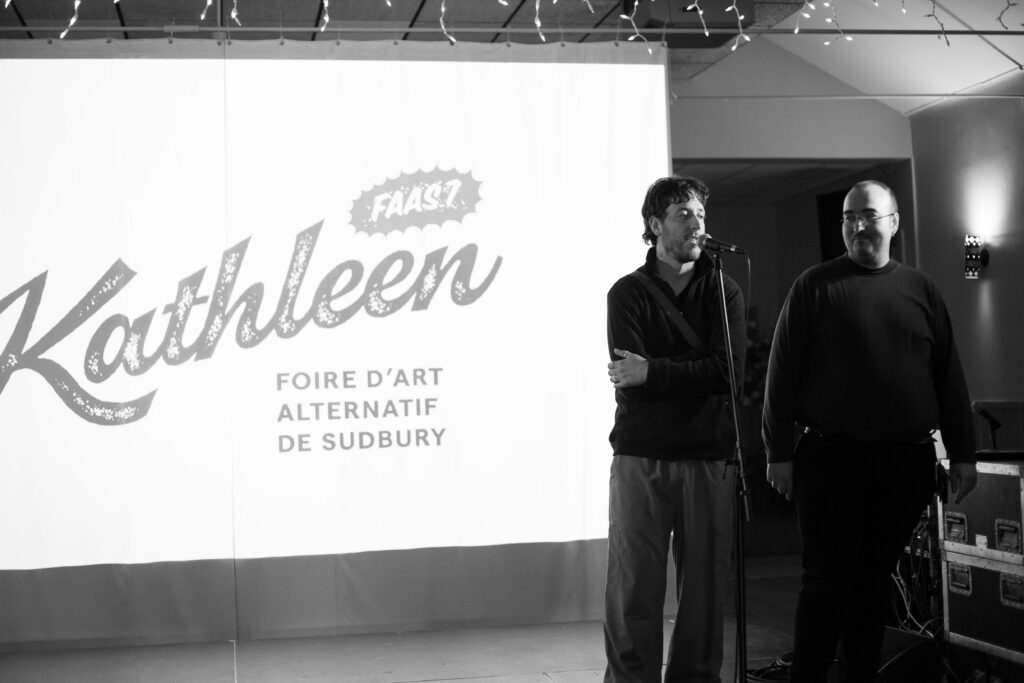
For its 7th edition, the Alternative Art Fair of Sudbury (FAAS) is taking over Kathleen Street in the Donovan neighborhood. Artists will create new installations, artworks, and performances in unusual venues. The public is invited to stroll through the area all week to see how the installations evolve. FAAS 7 will conclude with a festive opening reception for the installations and a presentation of the performances.
Introduction
Kathleen
Over the course of four days, some twenty artists from across the country will create original works and performances in full view of the public. Complemented by lectures and school workshops, this year’s event aims to foster discussion in an inclusive atmosphere. The event will conclude with a festive evening of performances and an opening reception for the installations.
With a focus on the neighborhood, the “Kathleen” edition is a wonderful opportunity to bring together the local community, show solidarity with the changes it is facing, and highlight its significant contributions. The Donovan neighbourhood is home to several ethnocultural and marginalized groups, as well as a new wave of individuals who are choosing to make it their home. This social diversity makes it a unique and diverse neighbourhood in the heart of the city. Inspired by the desire to create a space for discussion and exchange, this event aims to shed light on the workings of our urban and economic systems.
Since 2008, FAAS has taken over and transformed a public space in the “nickel capital” roughly every two years. Depending on the concept and parameters of each edition, artists are challenged to create a new work within a limited physical and temporal space.
The Galerie du Nouvel-Ontario (GNO) is an artist-run center that has been based in downtown Sudbury since 1996. It embodies a vision that embraces all forms of contemporary art, with a particular focus on site-specific work, installations, and performances. It encourages and supports artists in a creative process fueled by risk-taking and experimentation.
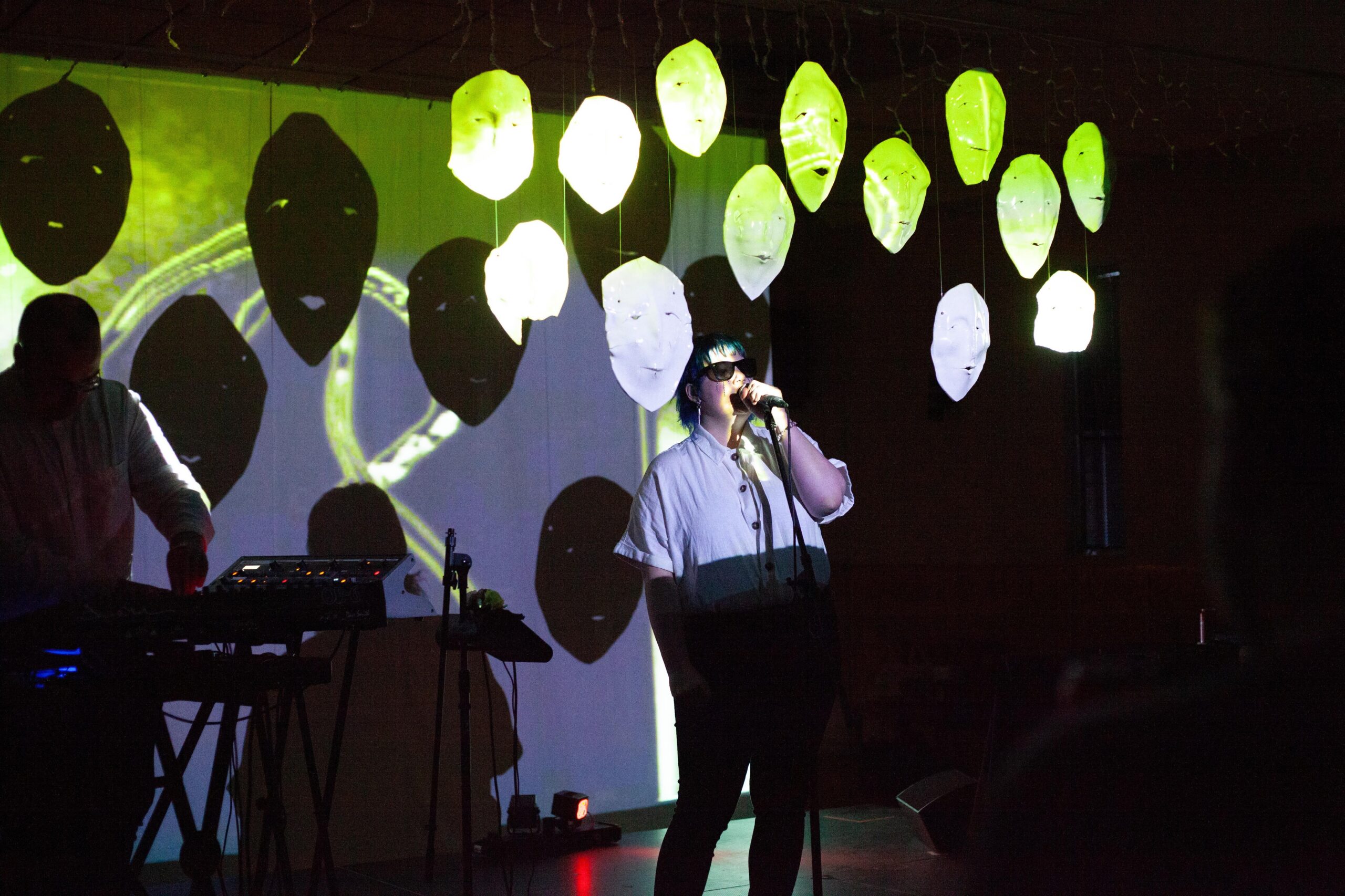
Performance, Fauxcils, 2023.
Ra'anaa Yaminah Ekundayo
What does it mean to be home?
Is it the feeling of being inside with a familiar roof over your head? Is it reconnecting with family after a long trip away? Is it a physical space, or does being home mean far more than inhabiting one specific location?
Architect Juhani Pallasmaa writes :
”Reflection on the essence of home takes us away from the physical properties of a house into the psychic territory of the mind. It engages us with issues of identity and memory, consciousness and the unconscious, biologically motivated behavioural remnants as well as culturally conditioned reactions and values.”
This is to say that perhaps the notion of home goes far beyond any single piece of architecture, but is rather something less tangible, like an unmistakable gut feeling. Although I wasn’t born there, and no longer live in the community, for me many aspects of home are associated with Sudbury, Ontario. When I arrive in the city, a familiar sensation washes over me, a sort of tumultuous comfort. As I embrace my chosen family, dine at my favourite restaurants and absorb the weird and wonderful artistic culture, I know I am surrounded by home.
In June of this year several artists from across these lands gathered on Kathleen Street, a space with an evident story. Through unique artistic interventions they came together to tackle the theme of “neighbourhood,” and contemplate what it means to participate in community, what it means to share in culture, and for many artists, what it means to create a sense of home. Widely considered a place of significant connection, community engagement, and above all a wondrous creation, the notion of home is so often embedded in the works of many artists. This is particularly evident in the work of multimedia Inuit artist Géronimo Inutiq.
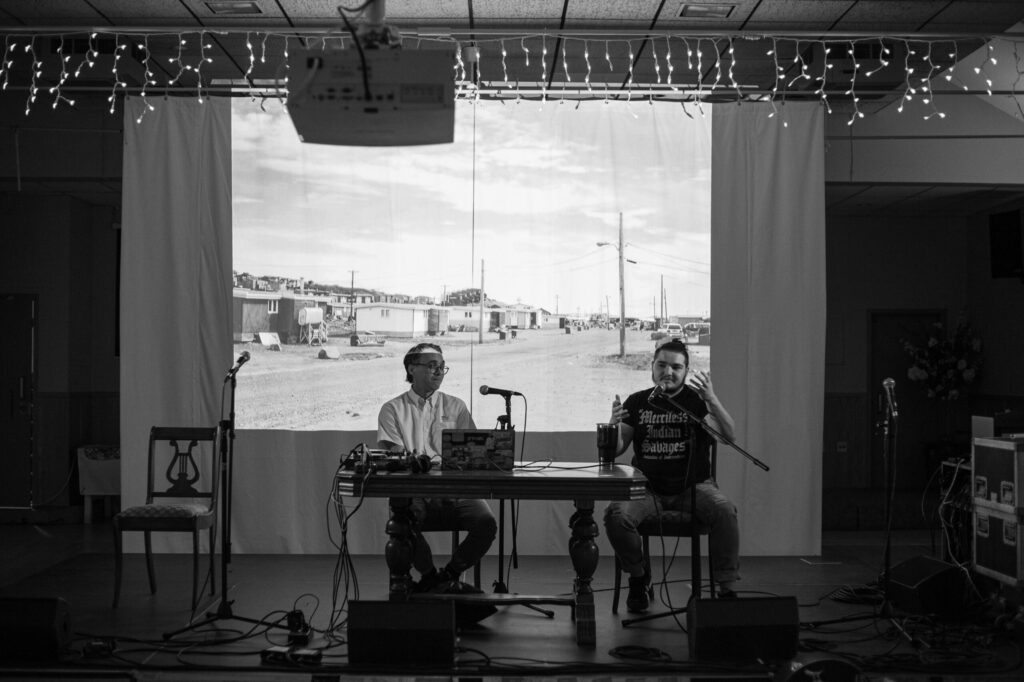
Throughout his time in Sudbury, Inutiq explored Kathleen, stopping to engage with Sudburians and inquire about their notions of home. Taking those profound audio bites and combining them with additional excerpts from the I’m Calling Home | J’Appelle Chez Nous project, he worked alongside local artist Connor Lafortune to bring spectators a remarkable live radio show unpacking these conversations. Lafortune, a recognized community poet, creator and performer from Dokis First Nations expressed his profound appreciation collaborating with Inutiq, stating that when confronted with his ideas on where home is he recognized that it wasn’t the city that was his home, but rather the people that he’s in community with, those that he invites into his actual home that bring out that unmistakable homely gut feeling in him.
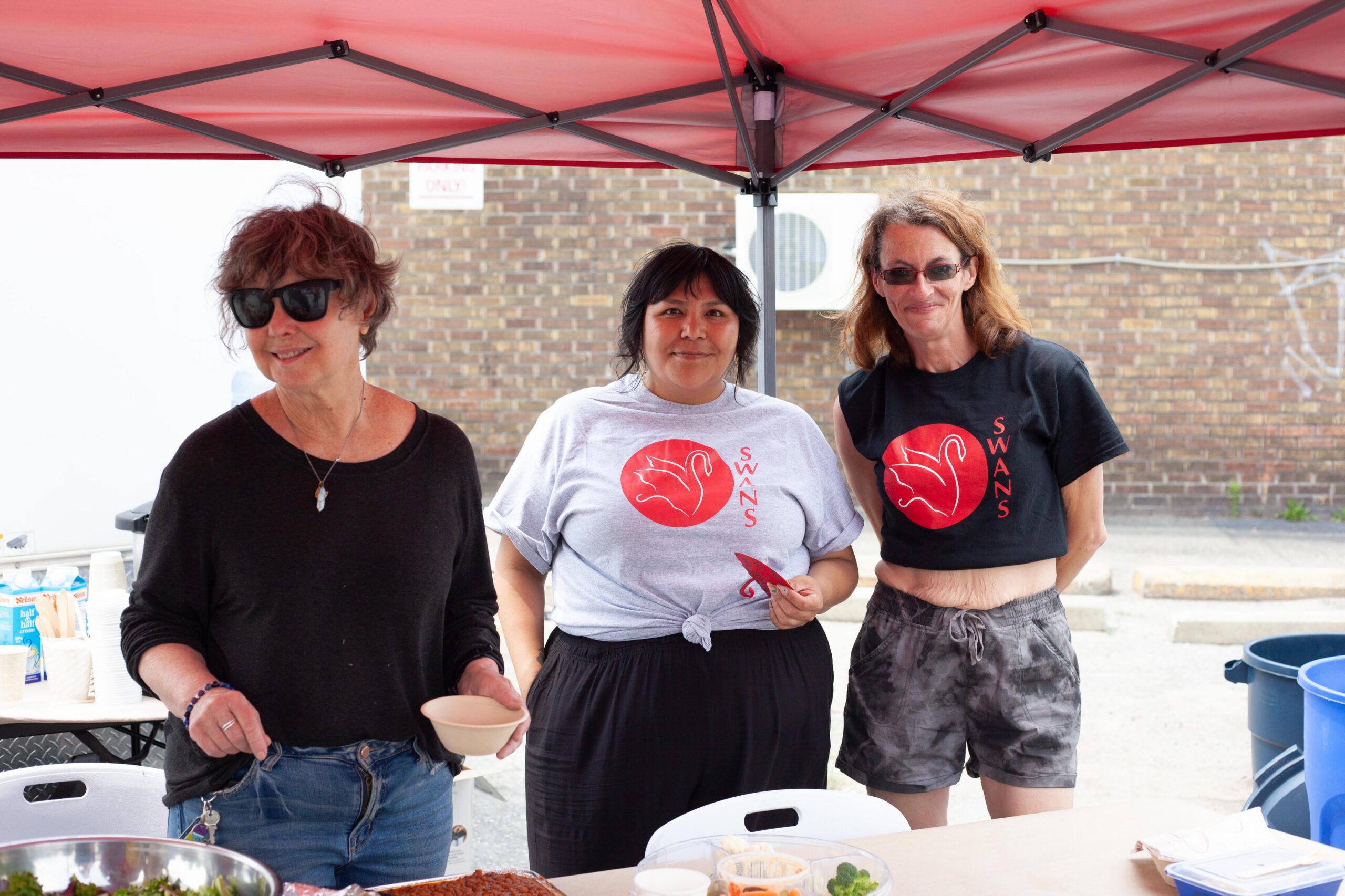
By sharing narratives that delved into diverse perspectives on the concept of home, these artists engaged in thought-provoking conversations surrounding home, positionality, and access. This thematic exploration further took center stage in the collaborative endeavour between Myths & Mirrors and SWANS (Sex Worker Advisory Network Sudbury). In a powerful direct action installation titled Meet Me Under the Red Umbrella, organizers Cora-Rae Silk, Laurie McGauley, and Tracy Gregory combatted preconceived notions of shelter and houselessness by creating a safe space for sex workers to engage in home-based activities. Named after the Red Umbrella Fund, a global initiative developed to support the rights of sex workers, this important artistic engagement sought to bridge the sometimes vast disconnect between harm reduction and community engagement strategies, a particularly pertinent conversation in Sudbury. Providing individuals with access to washrooms, showers, food, and above all a sense of community, this incredible activation pushed against ideas of what a home could be, perfectly illustrating the symbiotic relationship between activism and art.

In centering the lived experiences of sex workers, these artists forefronted a unique lived experience that is often marginalized on the fringes of society. The significance of elevating marginalized voices was also strikingly demonstrated in the remarkable endeavors of photographer and media artist, Alanis Magali “Ali” Rodriguez-Beaudoin. A racialized artist with roots in both Mexico and Northern Ontario, Rodriguez-Beaudoin utilized film photography and projection mapping to create a piece for multi-identity folks like herself, and those who don’t fit into what she called the “traditional Sudbury culture.” Capturing footage of community members dancing and overlaying it with texts of “HOME” and previously captured film and video footage, her work contemplated ideas of homecoming. As an artist whose practice navigates two nuanced cultures, this piece particularly spoke to bringing home to where you are, existing as a direct manifestation of Rodriguez-Beaudoin’s ideas of “people pollinating people.”
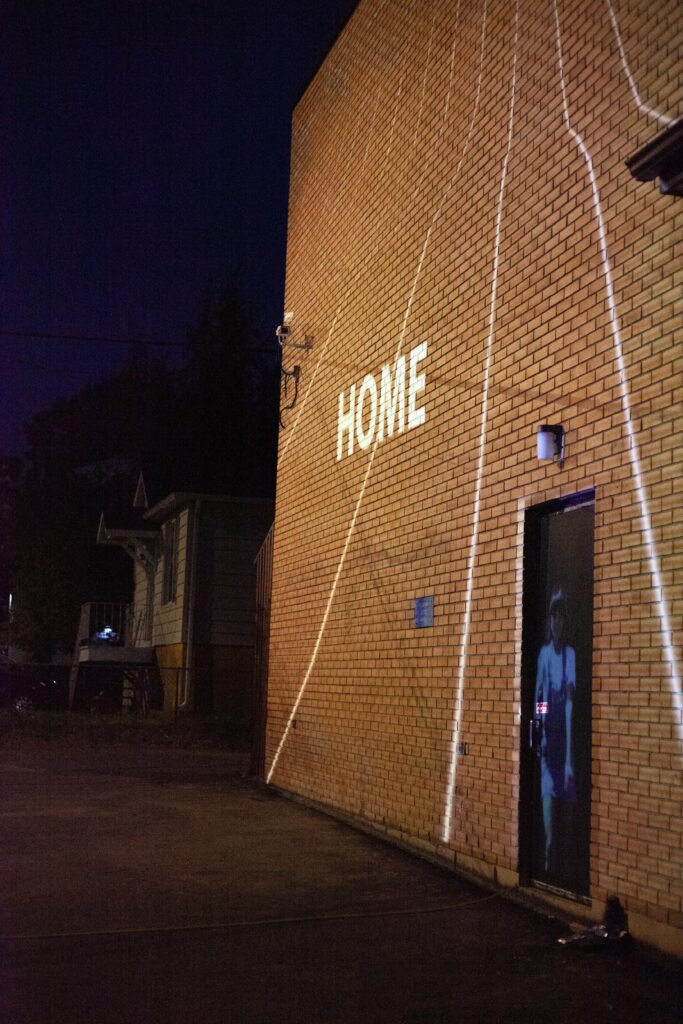
Much like bees gathering nectar from blossoms, this profound concept truly underscores the significance of absorbing wisdom from others’ experiences while leaving a piece of your own behind. This wondrous cultural exchange and mode of artistic sharing is a common thread in the practice of storytelling, and was highly emphasized in the initiatives curated by the Debajehmujig Storytellers. An Indigenous community-based artistic collective, this group uses the traditions of storytelling to engage with folks, accentuating traditional knowledge and teachings. In the context of FAAS, the artists provided multiple artistic activations including live storytelling, haptic painting opportunities, and the satirical “Warning Nanabush on the Loose” posters.

Nanabush, the main character of an Ojibwe legend, is a shapeshifter often portrayed as a hero, trickster, and teacher. Both divine and human, he represents the dualities of the living and natural world. His momentous adventures and teachings are woven into many stories with him serving as a mediator between the spirit and physical world. The Debajehmujig Storytellers’ evocative posters, spread across Kathleen, were a unique addition that brought viewers into their culture. For those familiar with Nanabush it became an enjoyable commentary, and for those not, an opportunity to immerse themselves in Indigenous culture and actively engage in an important learning opportunity. The artists’ innovative, and community engaged art provided a powerful site for thought-provoking inquiry, storytelling, and cultural politics. These themes were also deeply examined in the work of Jessica Karuhanga.
Karuhanga, a first-generation Canadian artist with British-Ugandan heritage, brings a rich perspective informed by issues of identity politics and the complexities of the Black diaspora. Through a multidisciplinary approach, she embarked on a profound journey through her performance-based practice rooted around the enigmatic Croatian Centre on Kathleen Street. With headphones on, her inner world concealed from onlookers, she delved deep into an immersive experience—perhaps channeling the site’s history and latent knowledge, or weaving a narrative tapestry with each nook and cranny, all while the spectators remained entranced in curiosity. This was an art of storytelling through presence.Her artistic practice further explores the intricate individual and collective concerns of Black subjectivity and embodiment, an inquiry which feasibly intertwines with the notion of home.
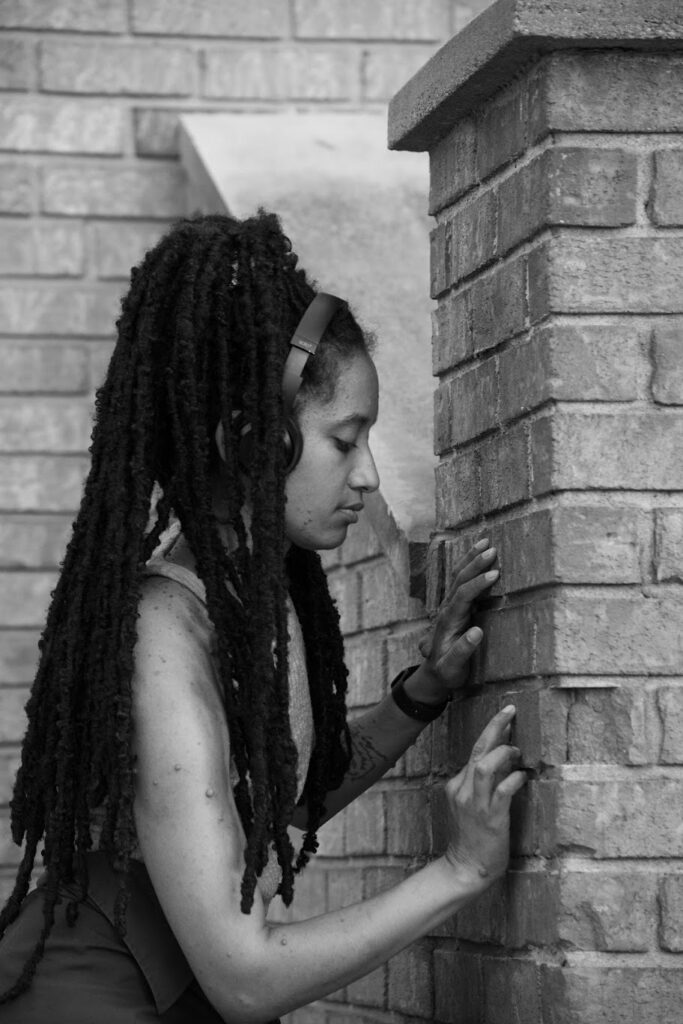
She masterfully weaves together threads of identity and belonging, contemplating what it means to create, inhabit a sense of home within the context of a Black diasporic experience. In doing so, Karuhanga allows for a reflection on the dynamic nature of home, a space not limited to physical location, but one of being entwined with one’s ancestry, and narratives of the past, present, and future. Through this exploration she invitds us to contemplate these diverse and rich expressions of diasporic home and identity, creating a powerful tapestry of storytelling through performance. Similar to Karuhanga, an artist with complex narratives to convey, multidisciplinary performance artist Florencia Sosa Rey also brought a significant and memorable perspective to FAAS.
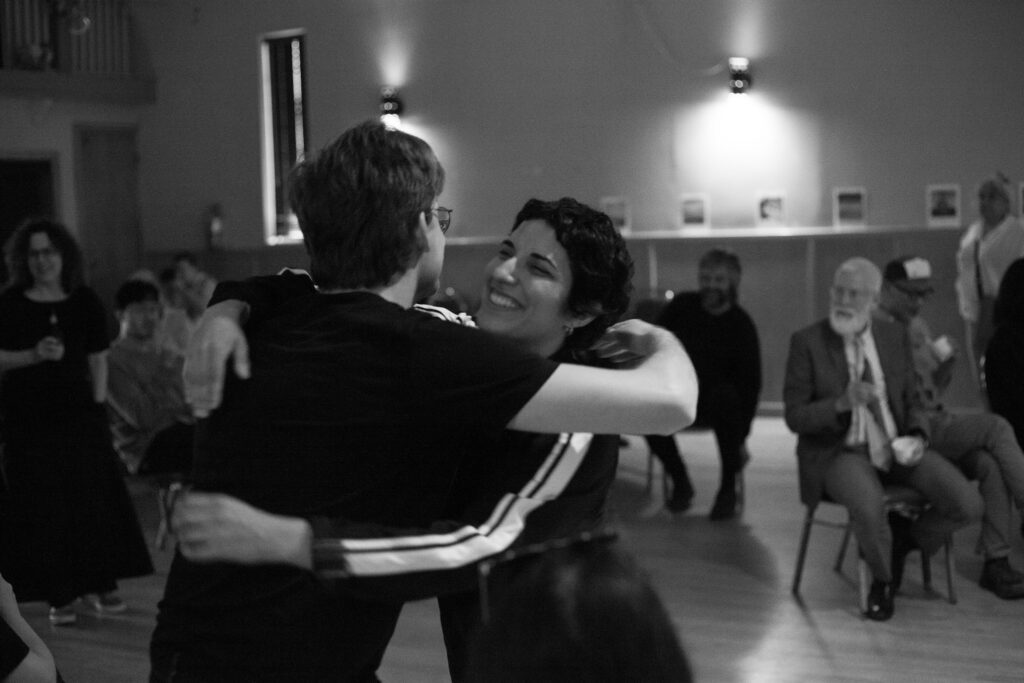
With her own distinctive style, and a unique blend of mediums, Sosa Rey added an intriguing layer of complexity to the space, infusing it with her own captivity and thought-provoking perspective. Her performance art took a captivating form through intimate artistic interactions orchestrated by the artist. Amidst the intermission of musical sets, Sosa Rey gracefully moved through the space, establishing delicate yet profound connections with community members. Offering cards and affirmations that celebrated the essence of human connection and intimacy, she invited the possibility of physical or verbal communion. Though my interaction with Rey was fleeting, it ignited a spark of warmth, an embodiment of the concept of home in its most profound sense. Sosa Rey’s work evokes a sense of home and community connection, a notion further beautifully encapsulated through the final artist of discussion.
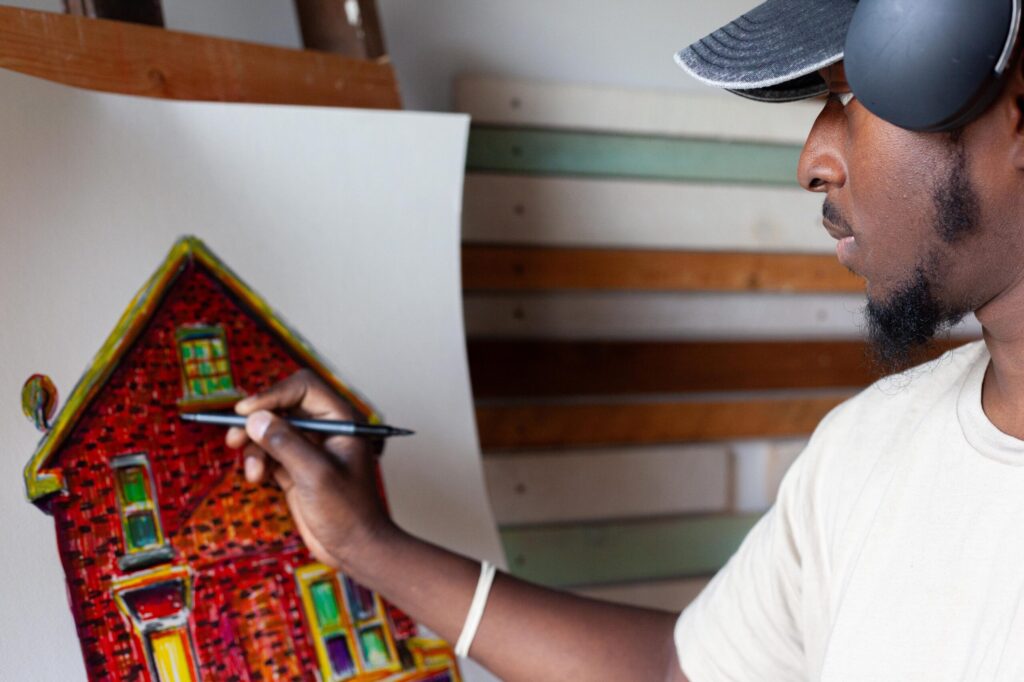
Rotchild Choisy, an emerging multidisciplinary artist from Haiti, centers his artistic approach on the intricacies of socio-political, and economic connections that individuals share with their environment. Throughout the entirety of FAAS, he posted himself inside Beards Bakery, absorbing aspects of Kathleen and taking in tales of the community. Extending his 2023 Neighborhood collection, he brought to life a vibrant portrayal of Sudbury’s architectural and historical landscape. Through depictions of staple spaces through a unique lens, Choisy reanimated these spaces, bringing new life and new eyes to the perspective of FAAS, the Nickel City, and the wonderful folks fortunate enough to call this community home.
This past June on Kathleen the theme of neighbourhood and home was truly embodied through the unique artistic uptake of the invited practitioners. Providing a remarkable platform for many artists of colour to engage in essential dialogue concerning not only diversity in the arts, but conversations on home and belonging, FAAS 7 curated an environment of several immersive artworks. Presenting distinctive and dynamic perspectives and lived experiences, viewers were invited to explore new dimensions of what it means to aptly contemplate and explore the sensation of home through art.
Artists Geronimo Inutiq and Connor Lafortune contemplate these notions through the mediums of sound and sensory experiences, welcoming the community into their thoughts and the perspectives of a variety of individual perspectives on home and connection. Myths & Mirrors and SWANS challenged traditional understanding of home, delving into questions of accessibility, access, and harm reduction. Alanis Magali Rodriguez-Beuadoin encouraged participants to reflect upon the possibility of bringing home to wherever you are, opening up to the nuanced notion of “people pollinating people,” and sharing one’s home with others, fostering a space of reciprocal exchange of experiences.

The Debajehmujig Storytellers masterfully engaged in storytelling and brought moments of oral histories to the forefront, inviting folks to engage in thought-provoking inquiry, and immerse oneself in the essence of cultural exchange. Jessica Karuhanga effortlessly merged conversations on Black subjectivity and the complex relationship between home and Black diasporic identity. And, Rothchild Choisy drew from his unique and vibrant artistic lens to encapsulate the Greater Sudbury Area, breathing new life into the city many proudly call home.
Through the journey of exploring these artists’ interpretations of home, it became abundantly clear that this notion is not merely a physical space, but profoundly rooted in a feeling, and beyond that reminiscence. Our material memories wield an incredible power to not only transport us back to a specific time or place, but further welcome others into that distinct space. Through the shared experience of art, we can enter into a collective narrative. FAAS allowed participants the opportunity to be brought into each artists’ interpretations of home, thus enabling the creation of a micro festival neighbourhood within the macro neighbourhood of Kathleen Street. Understanding this years’ principal theme, the works of these astonishing artists emphasize the importance of collective community identity among the rich tapestry of cultures and stories that each individual presented.

Overall, the 2023 edition of FAAS was a testament to the transformative power of art. In this, the true essence of home was emphasized – a place where we belong, connect, create and share cultural identities and narrative. Ultimately, these artists resonated with and played an essential role in shaping our collective sense of home and belonging, creating an animated neighbourhood within the heart of FAAS 2023.
— Ra’anaa Yaminah Ekundayo
Myths & Mirrors and SWANS, 2023.
Joséphine Rivard
TOURIST OR NEIGHBOUR:
My stay on Kathleen for FAAS 7
It’s June 14, 2023, and I’m heading west from Montréal towards Northern Ontario to attend La FAAS, la Foire d’art alternatif de Sudbury. As you read what follows, it’s important to keep in mind that my first-ever visit to this adjoining region is that of a tourist – or rather a neighbour from Québec – intrigued by a community that seems so close, yet so distant. Having worked in the cultural sector for over ten years, I was immediately enticed by this invitation, which made me realize that Franco-Ontarian culture has not been very present in my professional circle. Everything about this invitation calls out to me: discovering a new artistic community, seeing new country, the convergence of visual arts and performance, the human scale of the event… Right from the start, my conversations with Danielle and Philippe of the GNO make me feel like a neighbour in the back lane, warmly welcomed to the yard next door where they’ve fired up the barbecue, the conversations are stimulating and the laughter is genuine.
Neighbourhood is in fact the theme of this seventh edition of the FAAS and the event does project a spirit of friendliness, familiarity and togetherness in free-flowing everyday life. This year’s edition remains true to the fair’s original premise, which is to organize programming specifically around an untypical location, rather than in familiar cultural haunts. Under the title Kathleen, the event is a temporary set up on a street so named in a multicultural sector of Sudbury called the Donovan. The public is invited to come out to a villagelike area that offers a multitude of perspectives on what a neighbourhood can be. This community in the northeast part of the city is home to many different social classes, identities, cultures and ways of life. With its businesses, its former miners’ boarding houses and its gathering places for community and cultural groups, the Donovan is a multifaceted social entity that is quite appropriate as a location for a multipronged event like the FAAS.
The FAAS refuses to become sedentary and standardized. Rather, it invites its patrons to be curious and to freshen their focus by experiencing different environments. This distinctive positioning, which certainly enriches the event, leads me to reflect on the socio-economic effects of the institutionalization of contemporary artistic practices. My first stroll down Kathleen Street gets me thinking: Does art necessarily have to be disseminated on a massive scale to be meaningful? Why would we want to gentrify our practices, our spaces? What I immediately notice in my first forays into the heart of the fair is that it has chosen to repurpose venues without denaturing them. FAAS 7 is anchored in several key locations in the Donovan, like the barrooms of the Frood Hotel and the Croatian Centre. One of the organizers’ most significant decisions was to avoid promotional efforts based on discordant and out-of-place signage. Rather, they opted for a discrete promotional item familiar to all: a specially designed coaster in the colours of the Kathleen event. A subtle axis of infiltration allowed the FAAS to reach out to the local community simply by adding an inconspicuous bit of information to their day-to-day environment, without the use of invasive visuals. This simple gesture shows that relevant reflection prepares every edition of the fair.
Before getting into some of the fair’s remarkable moments, it should also be noted that the FAAS’ programming was designed on a human scale, in particular by avoiding an overload of options, which often results in decision fatigue and weaker audience engagement. The organizing team opted for consolidated activities and a schedule that doesn’t require choosing between simultaneous events, but rather allows the community to attend all of the programming. They chose to slow down the proceedings in order to foster moments of authentic rapport. And I must say that their vision of low-density scheduling was well appreciated.
It all got off to a start on June 14 at 7 p.m., as Geneviève et Matthieu opened the FAAS 7 with their presentation of Monsieur Gros (Mr. Big) at the Galerie du Nouvel-Ontario. This duo is regularly featured at the FAAS. They were part of the very first event and I’m told that they have taken part in almost all of the following editions, under their own name or with L’Écart, an artists’ centre formerly under their direction. Having them open the fair was an obvious choice, as these artists are friends and neighbours who are familiar with the event and know how to stake their place. In partnership with the Up Here festival, the GNO was certainly proud to present the duo’s latest creation.
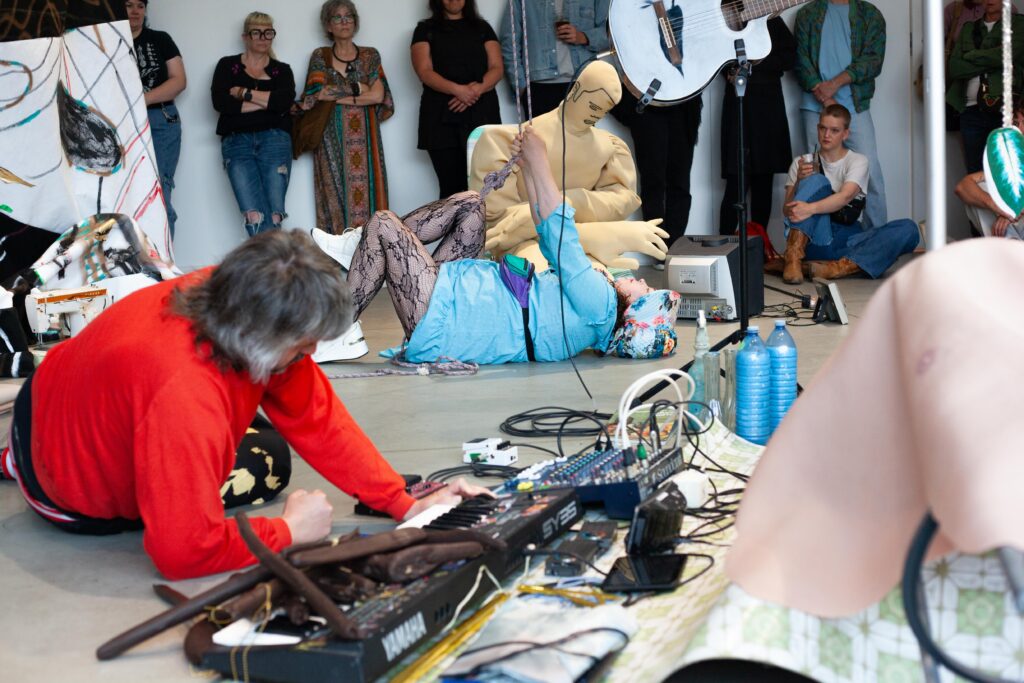
For the occasion, the duo presented a Monsieur Gros performance, combining music, poetry, stage design and sweet treats to give birth to an evolving, protean and definitely messy thing. A large audience, on hand for the opening of the fair, inserted itself within this dense installation, engaging with its components. In this baroque overabundance, we found ourselves plunged into a surreal detective investigation where many characters come and go and musical, sporting and gluttonous gestures abound.
It would be easy to describe this performance by commenting on its set design (gigantic piles of fabric, human limbs made of silicone, a trapeze hanging from the ceiling), its themes (investigative techniques, surveillance, identity theft, copying) or its positioning with regards to radical, opaque and experimental performance art. However, these avenues of reflection have been covered many times elsewhere, as Monsieur Gros’ was created in 2021 with many iterations all across Québec. I think I can be true to the performance by simply relating my personal impressions. Monsieur Gros smelled of latex and chemical blue sweetness. Huge Bébé Steve was as emotionally moving as he was disgusting. I laughed at Geneviève’s caustic declamations. I daydreamed as I listened to Matthieu’s music. I often feared that one or the other might injure themselves as they swung on the trapeze or fooled around with a knife or a neon light. Genevieve and Matthieu leave no one indifferent as they perform with vivacity and panache. It made for a fine opening night at FAAS 7.

The next day, a Thursday, I head out to Kathleen Street to start exploring the fair. There’s a lively atmosphere in the street as artists are busy setting things up for a schedule of creative events that will run until Saturday evening. The sun is out and there’s a strong sense of curiosity in the air.
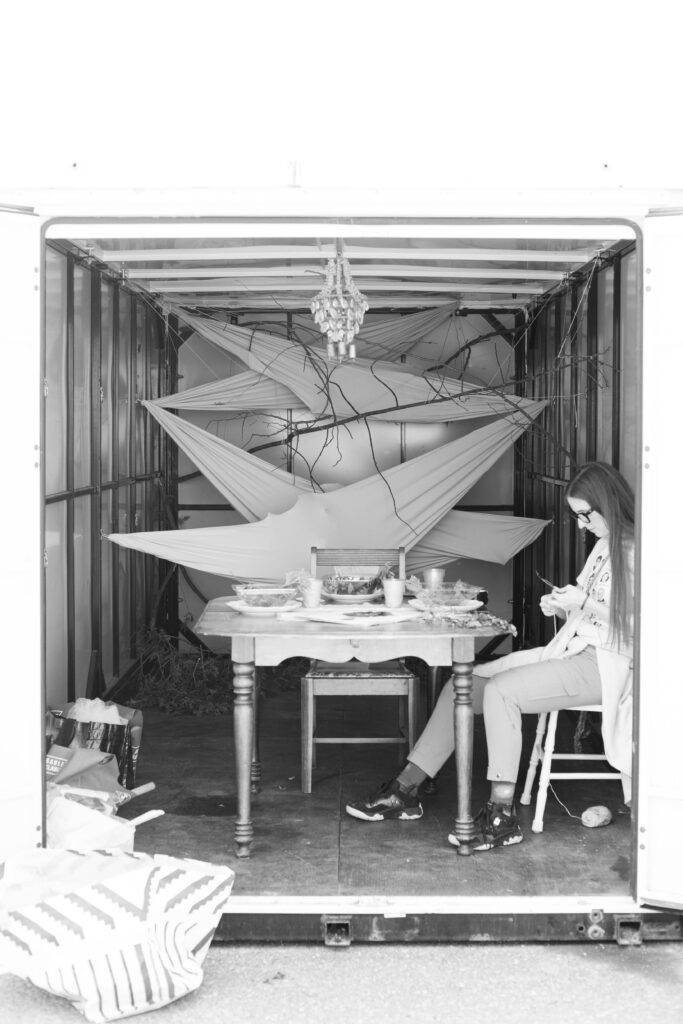
That’s when I meet artist Violaine Lafortune. She is originally from Montréal and now lives and works in Rouyn-Noranda. The fair has asked her to occupy one of its more unusual locations for installations, namely the container of a 20-foot truck parked on the Donovan’s main street. She affectionately calls this temporary workshop her “punk white cube.” Violaine is a seasoned observer and poet of everyday life who finds her substance in a multisensory experience of the world. For her stay in Sudbury, presented by the artist-run centre l’Écart, her self-conferred mandate is to position herself as a witness and record what she sees through a process of continuous drawing and erasing in succession, producing what she describes as “elegant outlines.” As soon as she arrives in the Donovan, Violaine begins an account of this new neighbourhood where she will be working. What strikes her first are time-worn architectural and functional elements, like wrought iron fences, municipal pipes and electrical wires. She commemorates these details in the simple aesthetic of her lead pencil drawings, but shortly thereafter, she erases them. In so doing, she highlights the still visible but increasingly unnoticed traces and the soon-to-be lost presence of things that no longer attract anyone’s attention. Some spectators who come to watch her at work find her ritual a bit disturbing. Her process of voluntary suppression straddles rationality and poetry, conveys a sense of mourning, evokes the endless cyclic rhythm of all things. Ultimately, these drawings will become part of a body of work she calls Le temps d’une cartographie (In a moment of cartography), which plays on the permanence of the objects she draws versus the impermanence of her drawings.
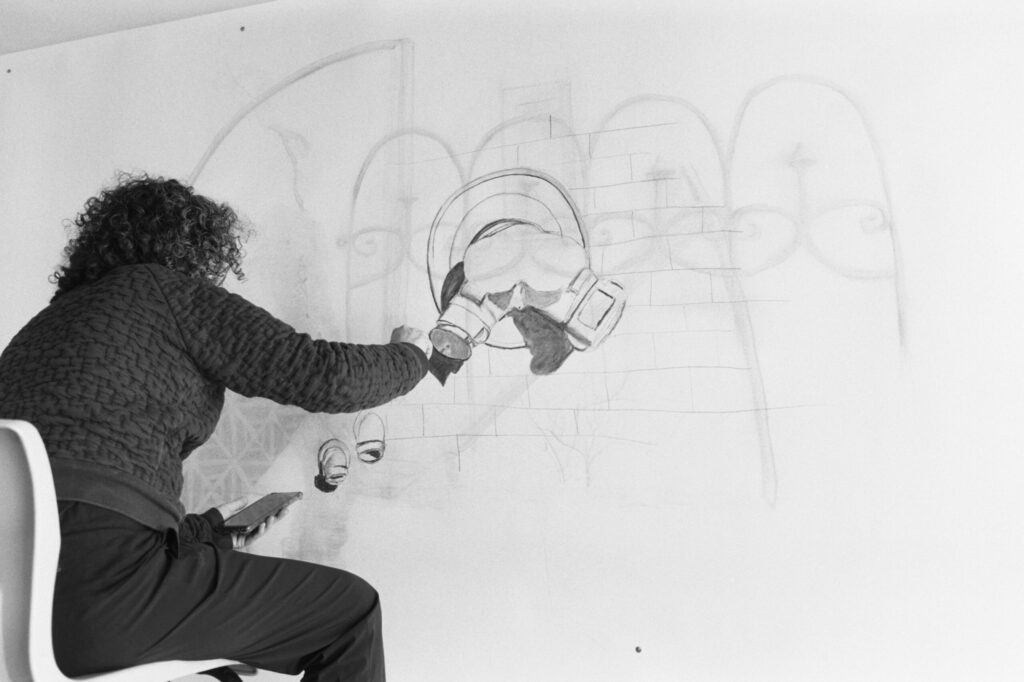
For Violaine, her role as witness was predominant in the “touristic” context of her stay in Sudbury. Her gaze was certainly not part of everyday life in the neighbourhood; after all, she was only passing through on Kathleen. She did not want to impose her views or to claim to be aware of the historical and material circumstances behind the things she was drawing. Rather, she chose to embrace the poetry she noticed in these details of ordinary life during her short stay. Violaine also drew a link between her Northern Ontario experience and her adoptive city of Rouyn-Noranda. Sudbury and the Abitibi region have in common a similar mining background and in this sister city with a similar socio-economic profile, the artist had a constant impression of déjà vu, as if she had lived here before. Mixing feelings of hospitality with impressions of desolation, Violaine Lafortune undeniably presented an empathetic portrayal of the city.
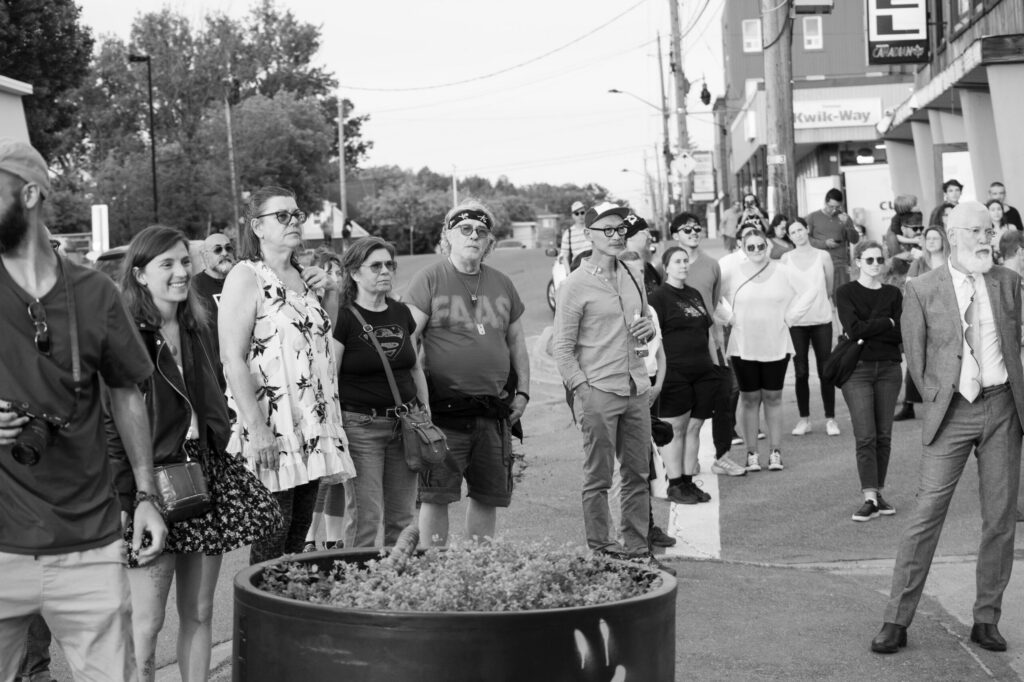
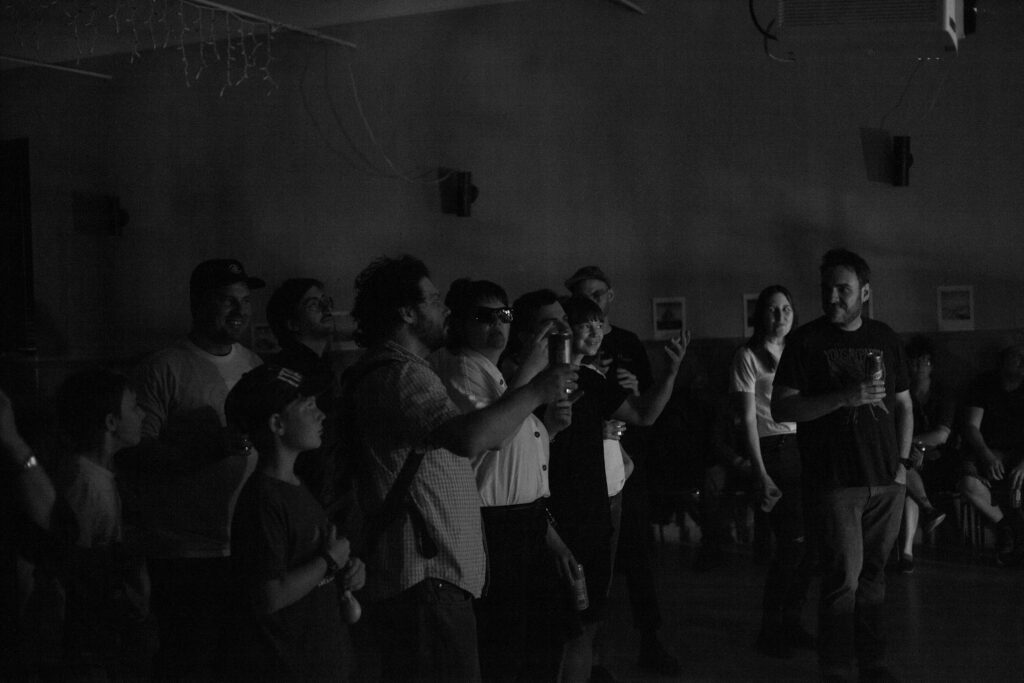
Following the days of live creation during which the invited artists inhabited the Donovan with their visual, community and relational propositions, the fair wrapped up on a Saturday night with a number of performances by artists from Ontario and Québec. Once again assembled on Kathleen, the GNO’s community of followers was there for the event and many faces had become familiar.
Johannes Zits kicked off this evening of performance art at FAAS 7 with Thinking of Yvon, a performance presented in the inside entrance of the Frood Hotel’s barroom. The arrival of our group of curious festival-goers seemed out of place in the dive bar ambience of this establishment, which obviously has deep roots in the Donovan community, but the regulars weren’t fazed and kept drinking their beer. Zits then began a performance which would gradually unfold in a sort of warm and welcoming anti-showbiz vibe, despite the presence of a number of formal elements to the contrary, like a stage area, lighting, a video screen and disguises.
Some key background information is needed to view this performance. In the year before this visit to Sudbury, Johannes collaborated with a friend, Karilee Fuglem, in an apartment on Monk Street in the Ville-Émard district of Montréal that served as their studio at the time. When the owner of the building decided to renovate that apartment, he asked them to empty it of all the belongings of a recently deceased tenant, who was completely unknown to the artist. Over the course of this housecleaning, the artist got an intimate look at the man’s life and tried to reassemble the pieces of a puzzle that didn’t necessarily have to be put back together. In particular, Johannes lingered on the man’s closet full of jackets, ties and shirts. Stashed in the bottom of a drawer, he also found a few homosexual pornographic magazines, hinting to the possibility of a concealed past. All of the man’s clothes were packed, unsorted, for delivery to Sudbury.
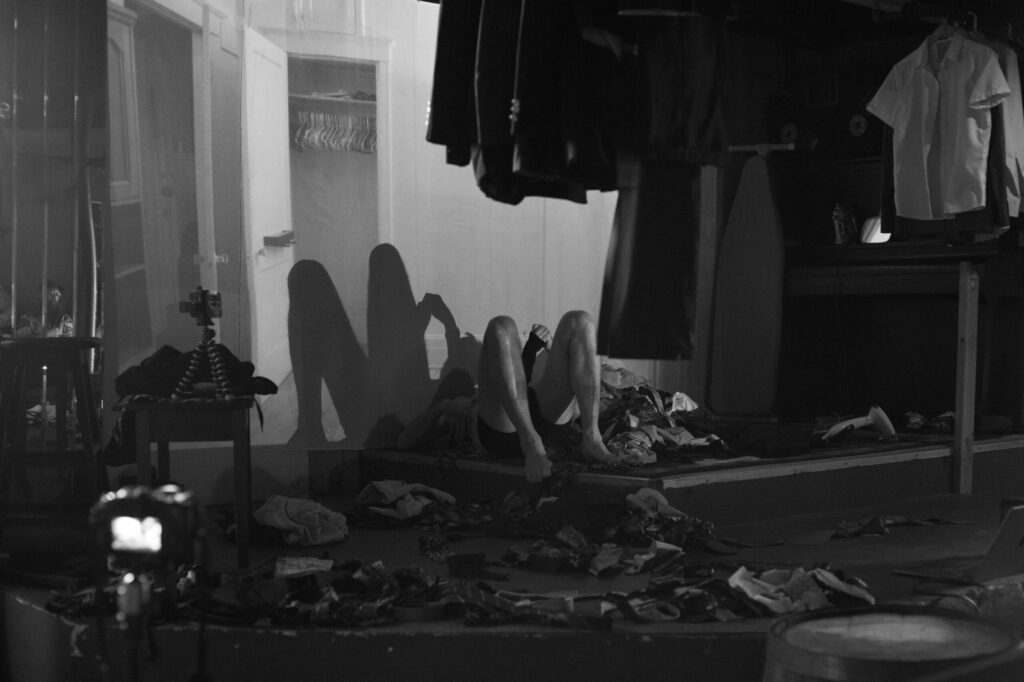
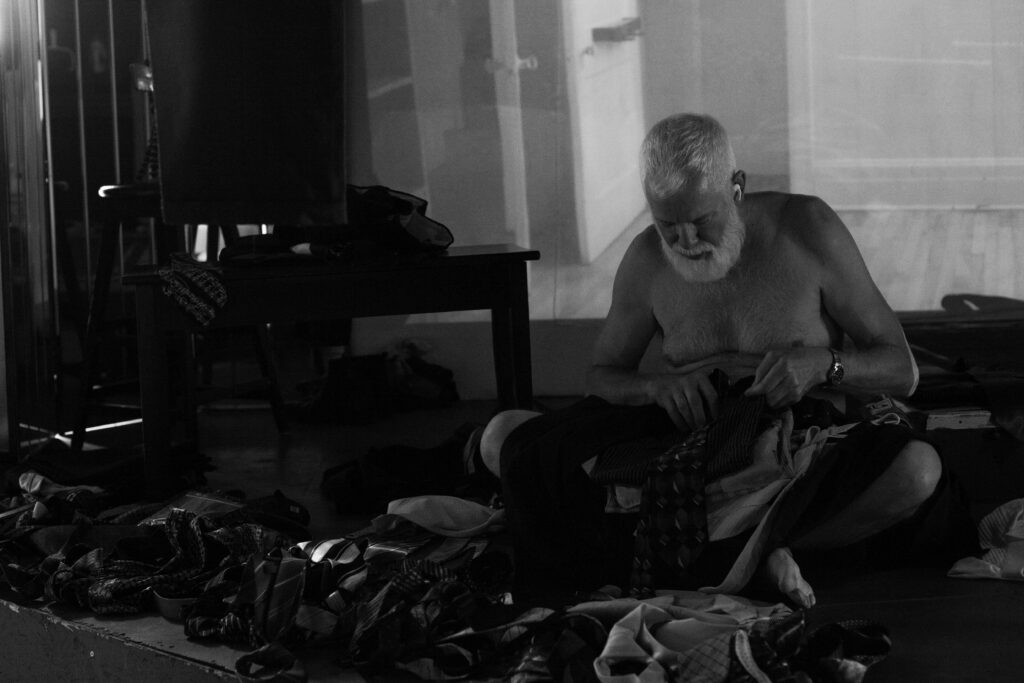
The performance centred on Johannes Zits unpacking ten or so boxes and donning the various garments and accessories on the barroom’s small stage. In a series of meticulous gestures, the artist tried on each item one by one. Throughout this public fitting room seance or non-fashion show, Johannes remained focused on the overwhelming quantity of clothes in front of him. He tried them on, folded them, categorized them and gradually became buried in them. Johannes exhibited each new outfit with pride and elegance. Strangely, miraculously, every item was a perfect fit for him. Behind him, a video projection showed the original closet that had been emptied and transported for this performance. Sometimes Johannes himself could be seen in the video, thus creating a ghostly double image reminding us of Yvon.
Over the course of the two-hour performance, Karilee accompanied the artist at a distance by videoconference while he exhibited each garment and tried it on in front of his little camera. Karilee’s presence had been important at the design stage, so it was essential that it be included in the completed work as well. Johannes explained to me that he and his friend simply talked about Yvon’s clothes while recalling memories of the past months. In the first part of the performance, their dialogue was quite sustained, but later on it dwindled when Johannes began to focus more on the audience members and interactions with them naturally increased, as Karilee and Johannes had planned. All told, there was very little artifice in this artistic proposition, but it certainly did not unfold without emotion. Yvon, the unknown, mysterious neighbour, had been given a unique tribute.
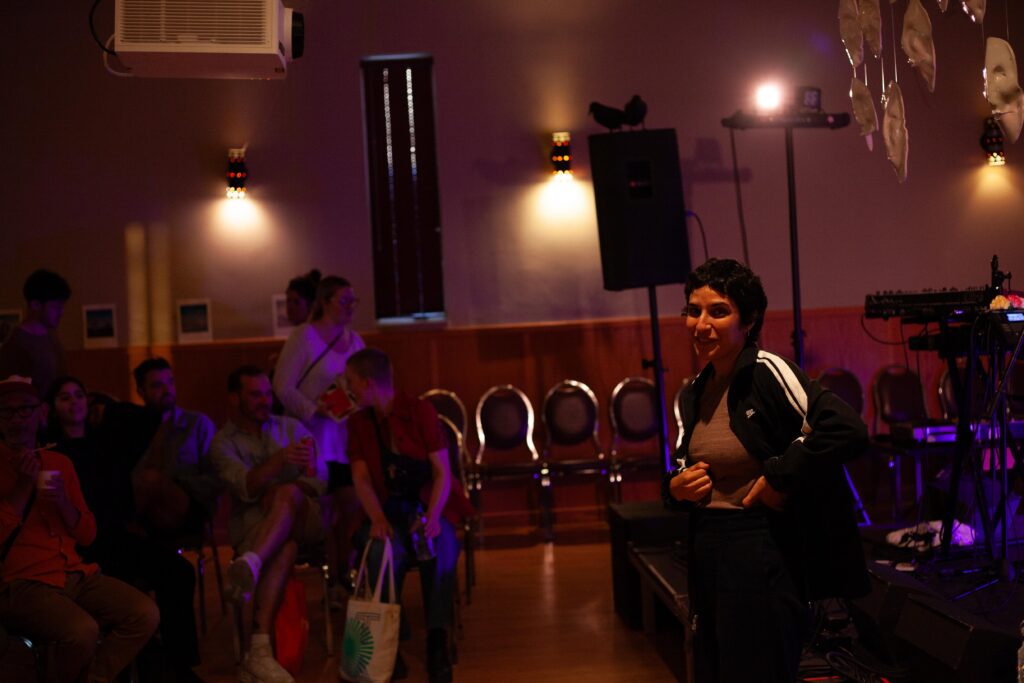
Later that evening, it was Florencia Sosa Rey’s turn to execute her performance in front of the audience. Following a number of performance art propositions presented outdoors on Kathleen Street, the artist invited the community to meet her at the Croatian Centre for The Colour of Distance.
Arriving in Sudbury a few days earlier, Florencia explores and encounters. This is a totally new context for her and this stay, though short, soon becomes highly revelatory with regard to notions of communion and decontextualization. Her practice as a multidisciplinary artist unfolds both in real life and in the traces left behind in memory. For this performance, presented by Centre Dare-Dare, Northern Ontario becomes the material to be used. The ideation of this work starts with simple questions. What does it mean to receive someone? How do hospitality and welcoming really unfold? Instinctively, the image of meal emerges: a recipe from her grandmother, the Argentinian countryside, a table, a friendly gathering of people who like to eat. However, after her arrival three days before her performance in the Donovan, a neighbourhood where she had never set foot, her ideas come together differently and her impulses need to be adapted to this new context. Florencia still wants to reach out to people, but her relational gesture will happen in a more furtive way, inside a circumscribed place, with no accessories aside from her voice and her body.
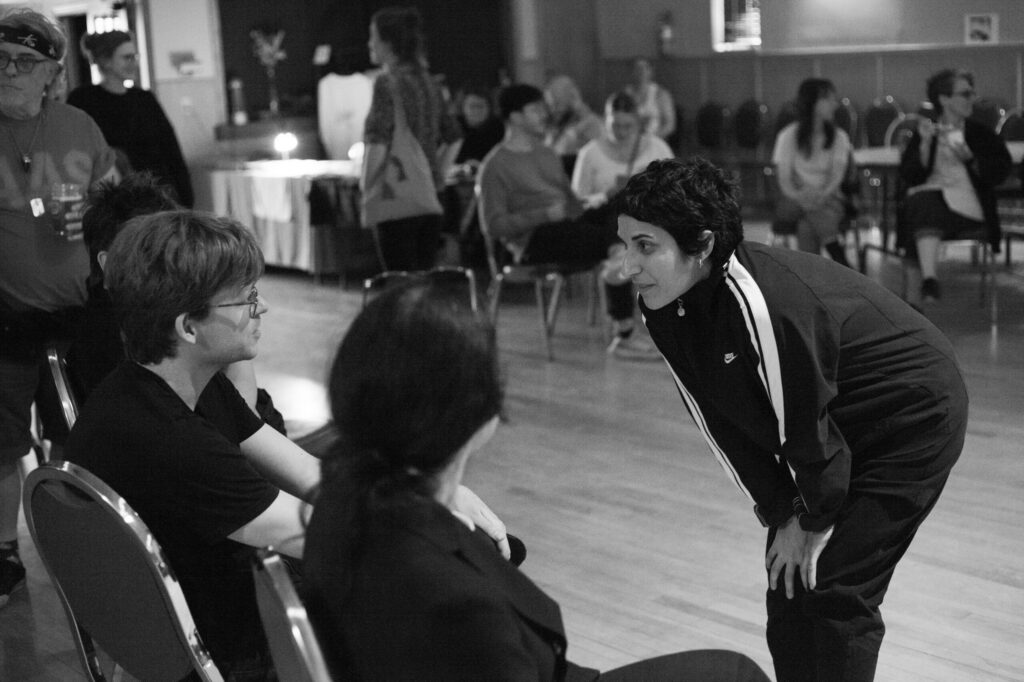
The Colour of Distance took place in the Croatian Community Centre. Similarly to Johannes Zits, who put on a sort of non-spectacle, for her proposition Florencia envisioned the authenticity of an understated, sincere and vulnerable presence. After a brief introduction where she addressed the audience, she proceeded to deconstruct the passive and hierarchical dynamic between performer and audience and initiated a ritual gesture to be repeated individually by the hundred or so people in attendance. Each interaction between the artist and an audience member took place in a similar manner: Florencia asked each person to show her their favourite gesture of greeting; then she repeated that gesture herself. Courteous handshakes, warm hugs, typical verbal salutations; Florencia’s infiltration extended placidly throughout the audience, ultimately crystallizing a certain force linked to the ordinariness of these gestures. With one little question, a lot was eventually revealed: openness, empathy and sociability, but also boundaries, shyness and fear. For Florencia, greetings became offerings and a step towards others, a manner of seeing and welcoming, a way of negotiating our different energies. Some fatigue ensued, but the artist finally did mobilize an entire audience by repeating an act of hospitality in its simplest form.
The idea of a meal was not entirely eliminated from the performance. A short poem, signed by the artist, circulated during the evening. Printed on a small dark-coloured card, it consisted of four short stanzas that trace the contours of a shared meal. Adopting various perspectives, Florencia put into words a fictitious memory, a feast rising from constructed nostalgia.
at a distance
one lies standing
to sing to sing
for a never-ending feast
until we meet again
Sharing does not require flamboyant intensity. Communion can just as well happen in an exchange of simple words. That is exactly what Florencia Soa Rey’s performance finally wanted to demonstrate, by greeting every person in attendance and dreaming of her grandmother’s Argentinian corn and squash stew.
I will conclude my report by discussing an installation that had been set up before the fair opened and that remained in place during the entire week, namely John Boyle-Singfield’s outdoor intervention in the Donovan. The GNO gave a carte blanche invitation to this artist who develops his practice in a multimedia and concept-based approach. The artist quickly focused his intention on producing a small, almost imperceptible change on Kathleen Street, where the fair’s activities were based. Having never set foot in Sudbury, the artist gradually developed his idea of making a significant, but non-disruptive gesture, in part through a number of scouting sessions on Google Street View.
The work Composition bleue was installed after successfully navigating a bureaucratic maze involving the GNO, the City of Greater Sudbury and its electricity supplier. Ten streetlights, on Kathleen Street, Frood Road and Antwerp Avenue near the railway tracks, were covered with blue filters. These Rosco lighting filters are normally used for film lighting: they correct and control colours and lighting when composing cinematographic images. Initially, these street lights are reminiscent of the “day for night” technique used to simulate nighttime conditions when filming in the daytime. However, Boyle-Singfield’s luminous intervention only becomes visible when night has fallen. During the day, it is barely noticeable on Kathleen Street, with perhaps only a small patch of blue in the upper corner of the eye. But after sundown, the filters remove almost 75% of the streetlights’ normal brightness, which inevitably makes a street feel less safe. From the fair’s opening to its closing, this installation remained discreetly imbedded in our comings and goings.
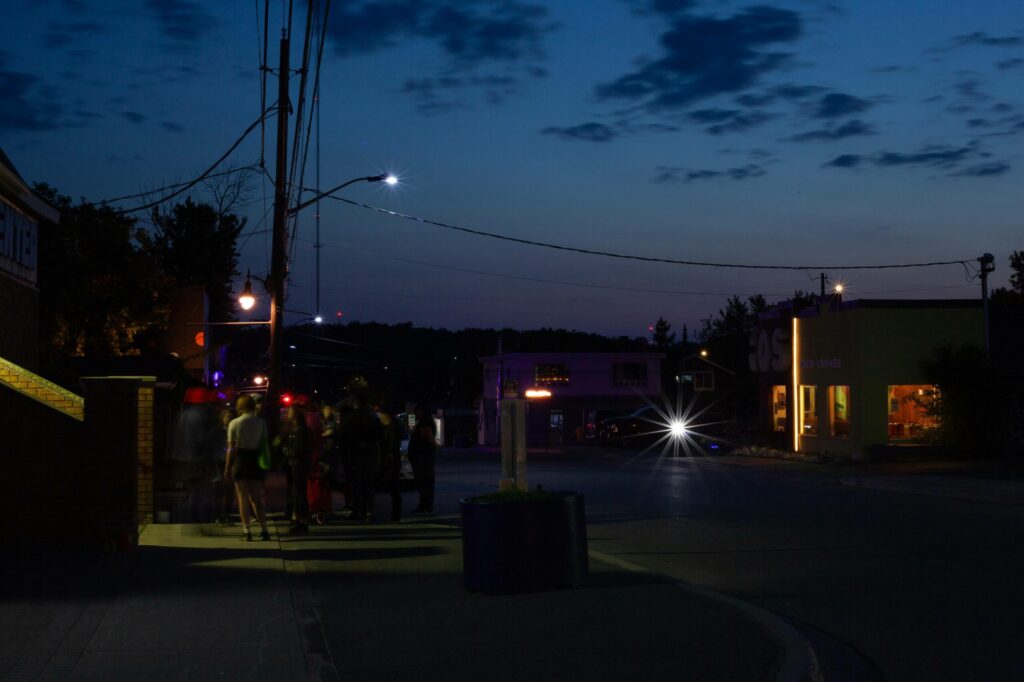
Composition bleue is a formal work that does not lend itself to a monopolistic interpretation and absorbs the context in which it arises. Inspired by the codes of cinematographic staging, it stems from the artist’s intention to create a tension between public spaces and images drawn from popular culture. Boyle-Singfield attempted to capture the visual essence of film media, the impression it leaves on our collective retina, by recontextualizing it in an ordinary place. One cannot deny that an event like the FAAS disrupts everyday life on Kathleen Street with its many visitors and the artists’ actions. Through his intervention, the artist shows that even though the neighbourhood has been occupied respectfully, the fair does involve the somewhat theatrical codes of contemporary art, such as opening events, performance evenings, etc., that contrast with the inhabitants’ routine. With a simple diversion of the neighbourhood’s street lighting, the installation “sheds light” on the FAAS’ temporary passage in the Donovan: have we simply been actors embodying predefined roles in this spectacle? Integrated into the post-industrial urban context of the Donovan, this work certainly points to the issues of security and the social problems present in this neighbourhood all year long. I see it as an invitation to call into question our roles and responsibilities as audience members and protagonists in the world of art.
John Boyle-Singfield was raised in Chicoutimi and his complex relation with his hometown resurfaced during his time in Ontario. Drawing on his experience in these post-industrial cities with a melancholy past and a withered present, the artist ultimately materialized the blues of an urban environment, as one might sense them while passing through downtown Sudbury, a city well known to his father who came here fifty years earlier to work in the mines of Northern Ontario. John has created a formal intervention that could easily be associated with 20th-century conceptual works, but his intention, he said, was not to exclude his emotional experience. It’s easy to take our street lights for granted, but they undoubtedly have a symbolic dimension. While physically accessible, they played a role in the FAAS by constantly navigating between urbanistic design, theatrical lighting and societal blues.
I believe that good neighbourliness implies respect for current mores and solidarity with our peers. As I reflect on this simple theme, I sincerely feel that it can be part of a long-term reflection on our various relationships within the contemporary art community. While the 2018 edition of the FAAS questioned the occupation of territory (under the theme question à qui, to whom), it seems to me that this year’s reflection centred on ways to occupy a territory together. Engagement with a neighbourhood can happen in a polite, a warm or even a hostile manner; it all depends on our own agency. It’s up to us to establish sincere, self-reflective and respectful relations in the heart of our surroundings.
— Joséphine Rivard
Translation : Normand Renaud
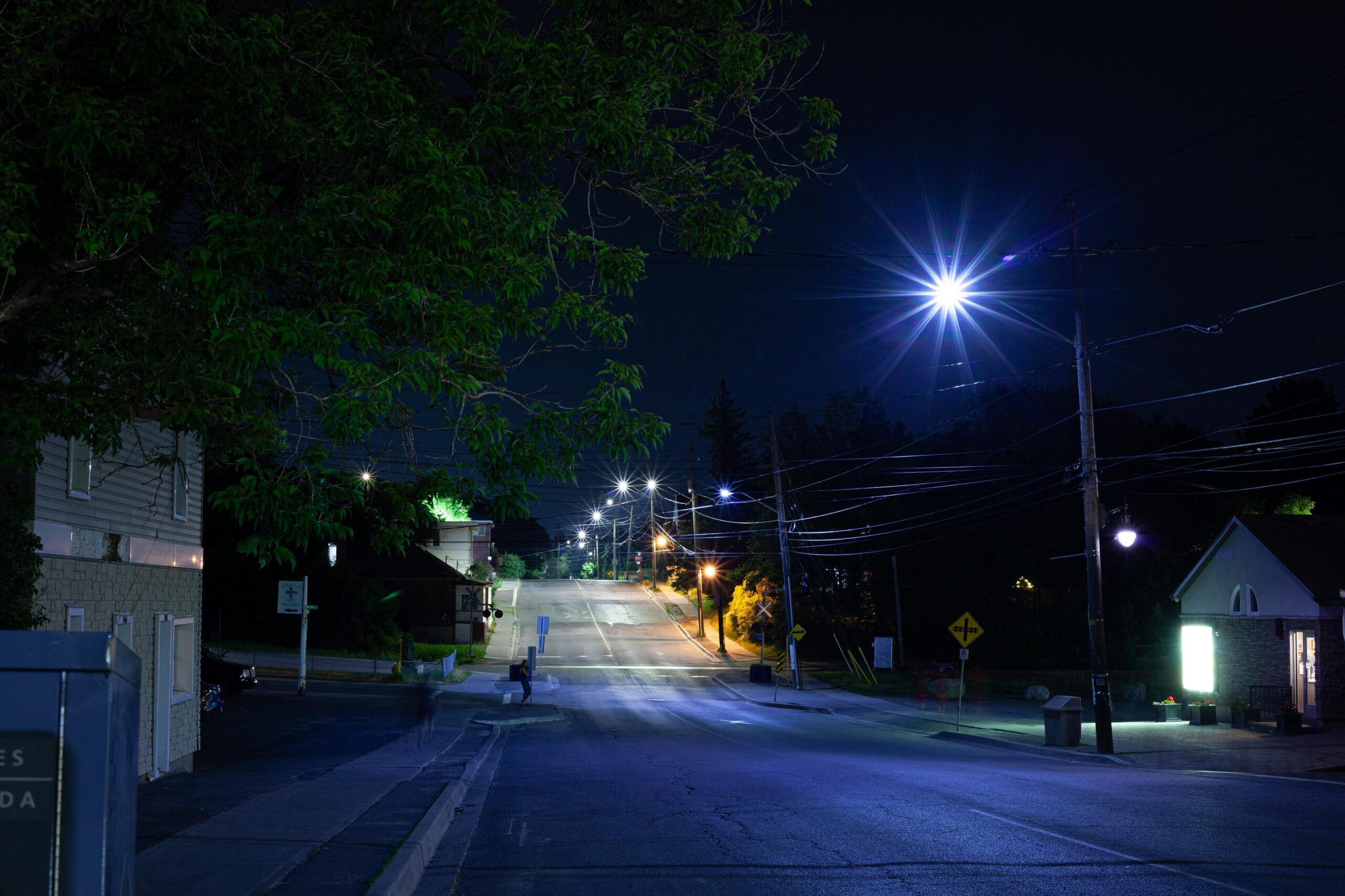
Composition bleue, John Boyle-Singfield, 2023.
Chloé LaDuchesse
We welcomed a new sense of place
I remember a meme that was circulating when I was looking to rent my first apartment in Sudbury. It was an image from The Lion King: Mufasa is showing Simba their kingdom bathed in light. Simba asks: “But what about that shadowy place?” Mufasa replies: “That’s the Donovan. You must never go there, Simba.” Despite the warning, the neighbourhood with the dubious reputation was where I ended up eight years ago. Not only do I feel comfortable there, but I also feel that I’ve developed a reciprocal relationship with my living environment, having written poems and a novel inspired by its streets and inhabitants. The Donovan nourishes me, and in exchange, I give back to the neighbourhood its own everyday life, magnified by literature, reverberating across the country.
I am intimately convinced that places are always tinged with the subjectivity of their people. Obviously, our perception of a place is influenced by the urban planning, the inhabitants and even the weather, but it always builds on a substrate of personal experiences, affinities and expectations, which grows deeper as time goes by. Here, on a winter evening, I recited a poem to a Tinder date. There, I stopped to talk with a sex worker about a kitten she’d just found. Every time I’m out walking, I am swarmed by dozens of images and feelings related to interactions that have left no tangible traces. I can’t experience a place without simultaneously being affected by the sum total of everything I’ve previously experienced there. I can’t carry a story within me and not feel its deep links with “tous les endroits où j’y ai cru [1].”
When I learned that the seventh edition of the FAAS would take place on Kathleen Street, in the heart of the Donovan, with Neighbourhood as its theme, I immediately knew that moving this event, this institution, away from the downtown into a mixed residential neighbourhood would certainly generate interesting conversations. Inevitably, the dynamics of a residential area are not those of a downtown core or an indoor venue. The usual crowd of festival-goers is bolstered by a crowd of curious or unconcerned passers-by who would unexpectedly find themselves experiencing something different. Will they be, like me, be permanently affected by an uncommon encounter? In one year or ten, will they remember that time at the Frood when a guy was trying on all sorts of clothes in front of his webcam? That time when wanted posters for a certain Nanabush appeared on all of the telephone poles in the area? And what about the artists? Will they be reminded of Sudbury when they cross paths with a friend they met at the FAAS? An intangible link is formed and added to the other layers of information that places communicate to us.
Two-way communication
As I write these lines, nothing is left of the FAAS on Kathleen Street. But in my mind’s eye, I still see the blueish hue of the street lights, and as I walk down the middle of Bessie Avenue, my footfalls remind me that for a few days, the street belonged to pedestrians only. By our presence and our actions, we transform our places, and our places transform us as well. That’s what we experienced in June: the streets doing what they always do, playing their role of community bulletin boards, unofficial channels of communication, means of transmission.
Upon arriving at the west end of Kathleen Street, you see the panels put up by Sudbury artist Nico Glaude, who typically leaves his work, often large-scale reproductions of memorabilia, exposed to the elements in public spaces. His contribution to the FAAS is in that vein: utility poles serve to display various messages and symbols that indicate to passers-by that they are in a zone of nostalgia. There are diverted logos (Ford becomes Froid, the French word for Cold), the New York Yankees’ logotype replaces the “n” in “lonely”); fictitious signage (“The Has-Been Inn” with an arrow pointing to the Frood Tavern); and winks to the artist’s Franco-Ontarian identity (a frog subtitled FFF, a yin-and-yang symbol with a fleur-de-lys and a trillium). The artist is exhibiting elements of culture that have affected him, but he is also distorting them to make them interact with the context. These creations blend in with the neighbourhood’s regular signs, announcing a garage sale or a lost cat, and panels informing citizens about local activities.

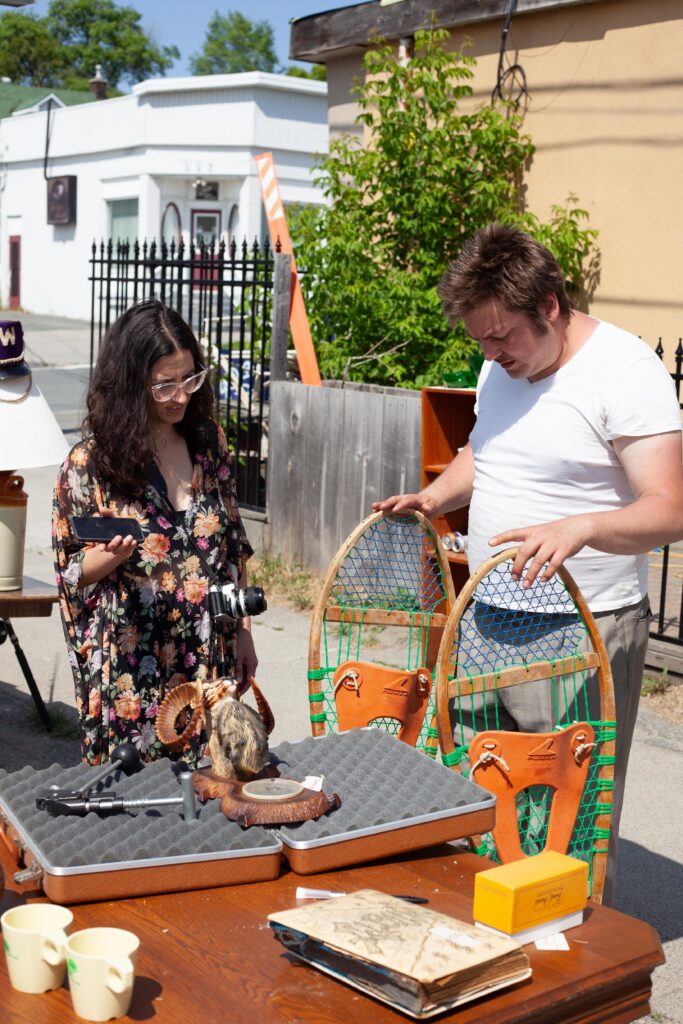
But what happens when someone is peddling untrue information? Selling Guy, a character created by Félix Hallée-Théoret, embodies the archetype of a salesperson who is not afraid to make up facts to make a sale. Setting up shop on Bessie Street during the festival’s Family Day, this artist’s tables display all sorts of second-hand articles he obtained from an extensive collection belonging to the Frood’s owner. Soon, onlookers come closer, intrigued by this garage sale, hoping for a bargain. That’s when Selling Guy springs into action, inventing an extraordinary background story for every article. Many of us tend to buy with our values rather than our judgment; we prefer locally made products or we fall for the feel-good storytelling of multinational corporations. Selling Guy is not new to the world of vintage and knows that his stories are worth more than his dolls, the invisible violin in his violin case, his rackets, his blank VHS tapes. This hockey stick? It belonged to Guy Lafleur! But he never could score with it, to the point where it’s thought to be… cursed. The salesman’s success is measured less in money collected than in the word-of-mouth buzz he soon generates, as these stories start to circulate among festival-goers independently of their creator. For my part, every time I notice two small espresso cups in my kitchen cupboard, I think of Selling Guy who, after long hours of sales pitches under a hot sun, had just enough vim left in him to confirm to me that, alas, there is nothing special about these cups.

I’m bringing a piece of the FAAS back to my kitchen, but Alix Voz has brought her kitchen to the FAAS. In a shipping container opening onto Kathleen Street, her installation is organized around a sturdy wooden table set with cedar foliage and glasses of water from Ramsey Lake and Minnow Lake. Northern Ontario is her home, particularly its lakes and forests – they are her medicine. Though the installation is transient, the space appears lived in: the walls are decorated with paintings by the artist and her grandmother, along with family photos. The highlight of the installation is at the back of the container. Suspended by woollen threads, nests made of stretchable green fabric extend across the cube from side to side. Wicker balls bulge within these nests, with lights placed inside them to cast shadows and reveal their depth. A table is a place for sharing, where one can be vulnerable, where the feeling of home is entrenched, especially since it also serves to welcome guests. The delicate string that supports the structures and runs across the entire installation represents the conversations that come naturally, the intimate moments that count so much more than concrete foundations or brick walls to turn this “house” into a home. Alix Vox has made CANO’s words her own: the famous lyrics viens nous voir (come see us). As passers-by stop and ask questions, the feeling of togetherness that wells up in this kitchen will hopefully spill out into the street, the neighbourhood, the community.
Acts are performed and their traces remain
The basement of Cosmic Dave’s Guitar Shop has turned into a strange and luminous forest. This is where Alyssa Scott has staked her place for the duration of the festival. Her contribution, Dans l’ombre du soleil / In the shadow of the sun, consists of three works. After descending stairs scattered with tree leaves made of paper, we reach a large wooden structure in the form of a half-circle reaching almost to the ceiling, draped with long backlit strips of Washi paper on which those same leaves are printed and whose ends have lacy cut-outs. Completing the set-up, two videos are projected, one behind the structure, the other on a nearby wall. They both show the artist’s family homestead as seen “from an insect’s perspective.” To create the final videos, the artist started by projecting the filmed images on the walls, ceilings and interior staircase of a barn on the property, and then she filmed that projection. The resulting images combine the hues and textures of plants, fences and stumps with those of the building, thereby revealing a different perspective on the utilization of space (unlike insects, we mostly stand on the ground) and on the porous divide between inside and outside which is characteristic of rural life and, more generally, of any environment that has been transformed to make way for humans.

Both comfortable and concerning, Alyssa Scott’s world seems to stand at the edge of a place that is familiar, but slightly unusual. Seemingly deposited by autumn winds, the sheets of paper guide spectators towards seats that invite them to spend time with these works. The very nature of the exhibition space – a commercial building in the Donovan – suggests that spiders and mice might be seen there, reflecting the critters’ perspective adopted in the video. The installation’s soft lighting contrasts with the chilly and dusty dampness we imagine as we explore the nooks and crannies of the barn. All of these components remind us that nature still exists and obstinately leaves traces everywhere, whether we notice or not.
In her own way, Violaine Lafortune also blurs the line between inside and outside. In a cube van parked on Kathleen Street, she draws on large sheets of paper covering three of its sides; only the van’s loading door remains open to the street. Using charcoal, she draws things she notices during her daily walks in the neighbourhood, but when evening comes and no one is there to see, she erases her work. At that’s left on paper is a ghostly presence, on which she superimposes new discoveries the next day. Her considerations are esthetic, rather than thematic. What catches her eye are some textures and details of the built environment that aren’t noticed at first glance or that are ephemeral in nature. Then comes the pleasure of composition: what to draw, and at what scale, over this trace that is left on the wall? Like a tattoo overlaid with new ink, it becomes a matter of working with what’s already there, rather than trying to obliterate it.

There is something radical in this act of erasure: it lets the drawing venture to where the prospect of permanence would be a hindrance. Like Penelope, Violaine Lafortune undoes her work every night. In so doing, the artist reaffirms that she is free to decide how her time, energy and inspiration will be spent. However, in a first for this artist who used to work on walls directly, she now has the opportunity to unhang the sheets of paper and bring them back to her home in Rouyn-Noranda. In one fell swoop, the ephemeral becomes permanent, yet disappears from the neighbourhood.
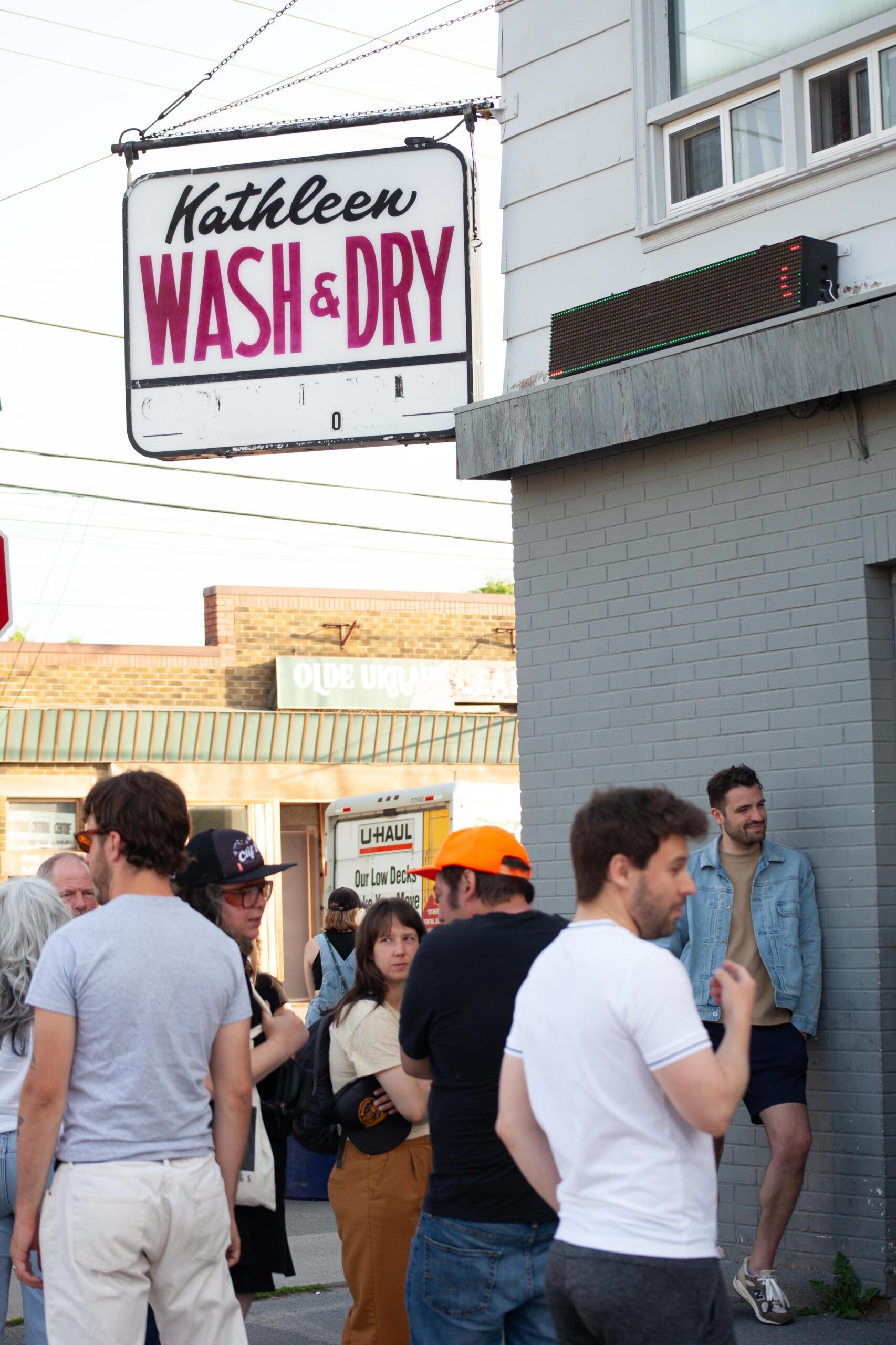
To be on the side of the hand that holds the blade is one of the driving forces behind Alegria Gobeil’s performance. With no fanfare, the artist exits the Frood Tavern, where the audience has gathered, dons a white coat resembling a straitjacket and, leaning on the outside wall of the bar, cuts their hand five times with an exacto knife. Their hand bears the traces of other performances, but here, for the first time, the artist has decided to perform this act – cutting – in a public space, knowing that it might wrongly be perceived as an endorsement of such practices (more about that in a minute). Then, the artist walks westward down Kathleen Street to the Kathleen Wash and Dry and enters alone. The blouse is put in a washing machine, while they reflect on what will remain of their performance, once the blood has disappeared.
In the psychiatric community, self-injury is considered pathological; in the realm of art, it is a way to assert a person’s sovereignty over their own body. Through this performance, Alegria Gobeil exposes power relations in the medical community – after all, who decides what is “healthy” or “sick”? – and raises the question of consent to care. Informed by extensive readings on this topic, excerpts of which are copied and pasted to utility poles on the street, the artist uses an act deemed “self-destructive” as a basis for reflection on artistic privilege and the artificial segregation of behaviours depending on the contexts in which they are exhibited. The performance, so brief and furtive, makes me ponder what distinguishes the FAAS’ three days of quirky outbursts from oddly similar behaviours exhibited by the neighbourhood’s inhabitants in the rest of the year. After all, on the first day of the festival, someone mentioned to me that they enjoyed the in situ intervention of a man on a bicycle… who in fact was just a colourful local resident. As Alegria Gobeil recognizes, with the status of artist come certain advantages, such as becoming a part of – and then being apart from – The Donovan.

The contamination of identities
On Saturday night, as the FAAS is drawing to a close, the small crowd heads to the Croatian Centre to see the last performances. The Sudbury duo Fauxcils, formed by Dunstan Topp and Jenn Herd, stands on stage in a décor made of many white ceramic masks produced by Topp. In the context of the FAAS, the band has a rare opportunity to extend its music and performance into an installation that is more complex than what is possible in the bars where they usually play. The sounds of the synthesizers and sequencer hark back to the 1980s, while the voice, modulated by reverb that swallows the lyrics, imparts a certain gravity reminiscent of early 2000s indie rock (think The XX, Warpaint, etc.). The duo plays with the codes of glamour: the sparkly make-up enlarging the eyes, the sunglasses, the choreography around the suspended masks; it all contributes to the impression that this band both reveals and conceals who they are, as if layers of identity could be peeled away endlessly. What stems from the stage persona, what is authentic, and is it even important to distinguish the two? While the music plays, I’m willing to believe that we’re patrons of the glammest bar in town.
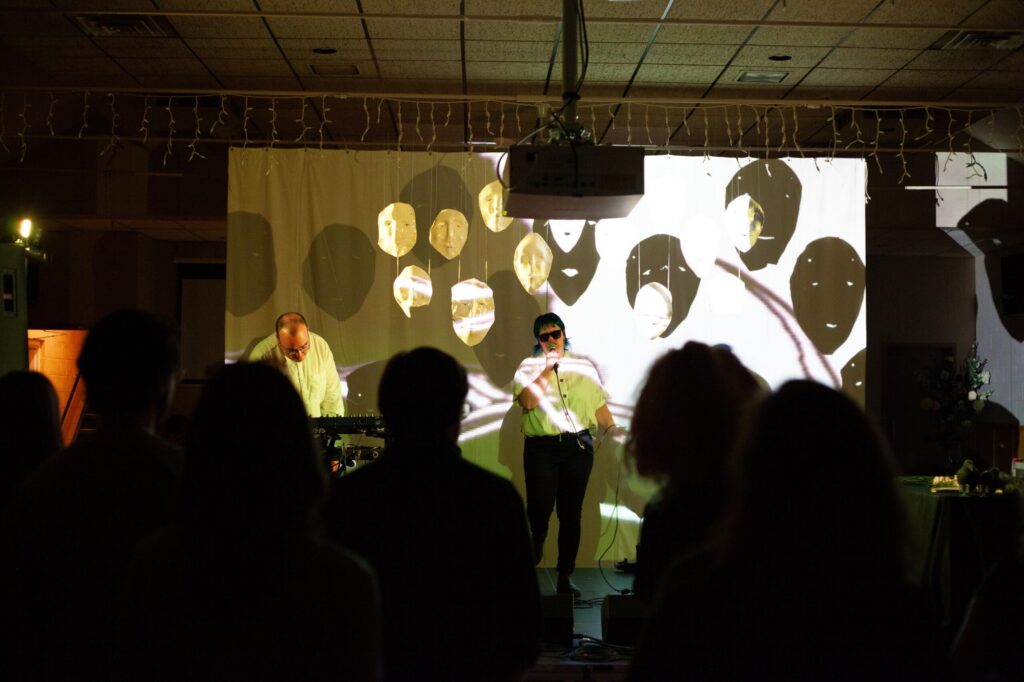
Though Sudbury has already welcomed her several times as a member of the bands Duchess Says and PyPy, Annie-Claude Deschênes takes the stage at the Croatian Center this evening as a solo performer. Developed during the pandemic, her solo work combines rhythmic and unyielding electronic noise music with a performance inspired by the new social norms and public health rules that appeared during the COVID parenthesis. Alternating between her consoles and a minimalist restaurant décor – a table, a chair, some tableware – the artist plays the waitress, mimicking the gestures of table service. Projected in the background is a video created by Anthony Piazza, featuring images captured live during the performance, but also food, kitchen utensils and computer code. Frankly, when you’re attending an Annie-Claude Deschênes performance, you’d rather dance than sit and take notes, so dance I did, with great pleasure, communing with a crowd electrified by the artist’s beats and incredible stage presence. In an interview, Annie-Claude Deschênes mentioned that her solo project is a reaction to the absurdity of new rituals surrounding the restaurant dining experience: the plexiglass, the distancing, the vaccine passports. Nobody feels the weight of such rules as we bounce to the rhythm on the dance floor, not as individuals each in their own bubble, but as a fascinated audience, heeding the slightest call of an artist whose only concern with norms is how to move beyond them.

The Distance Between Us collective presents Offerings of Care, the last performance of the fair. Elyse and Emilio Portal and Tara and Clayton Windatt formed this collective during the pandemic around themes of isolation and new relationships with territory, using a variety of techniques, including audio sampling, collecting pigments, performance, installation, video and writing. Their interventions are often improvised, based on parameters predefined by the group. Each member is free to bring their own contribution to a work under development, to which the others respond. At the FAAS, this takes the form of a video projected on an outside wall of the Croatian Centre. The images were captured during wanderings in the neighbourhood, along the railway that runs alongside Nolin Creek just west of The Donovan, in the Kathleen Wash and Dry and on the trails circling Bennett Lake in Sudbury. The video superimposes various images, including natural features, passing trains and images of Elyse Portal collecting pigments from rocks. From inside his car, Emilio Portal produces a live soundtrack for the performance, using sounds collected during walks in the forest with Elyse and their son Teo, who is heard spelling out new words. Standing in front of the projected video, Clayton puts on a white protection suit and then lies down on the pavement. Using ink prepared by Elyse, Tara writes a string of words on the jumpsuit: teach, listen, believe, try, cry, care, rest, respond…
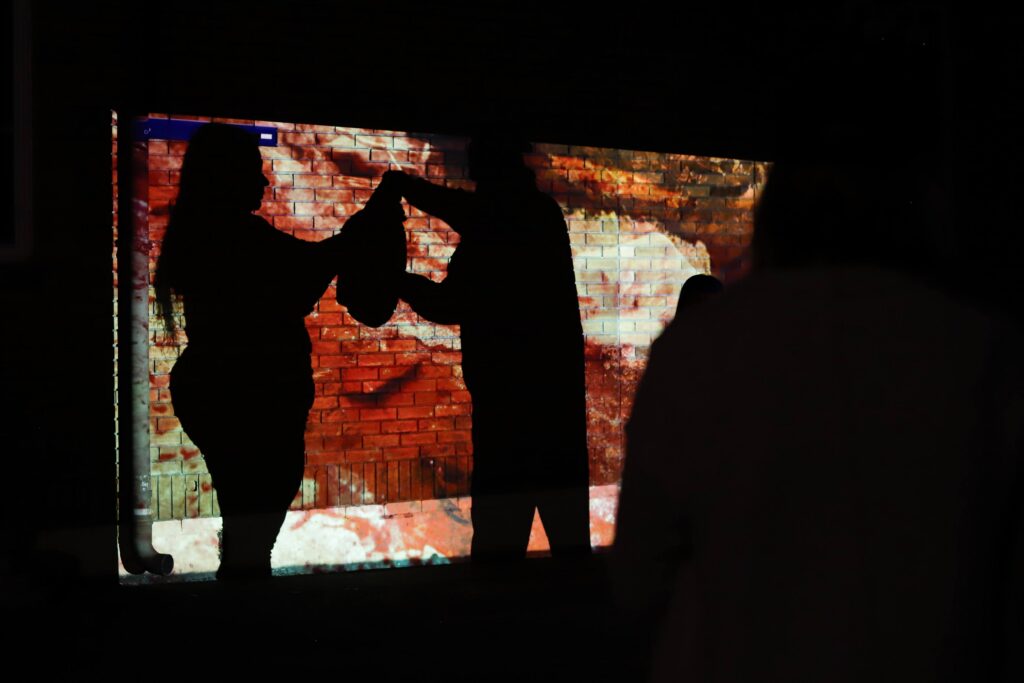
The performance lasts a long time and is conducive to meditation, even if it is not quiet. The soundtrack is sometimes cacophonic, while the images show a newscast on a TV screen: forest fires, war in Ukraine. However, Tara’s patient work and the words she chooses inspire a form of hope. There is something very beautiful in these excerpts where we hear a child learning to spell – to decode his world. The collective explores the city’s fringes, wonders about a parallel history for this territory, had it not been colonized, exploited and connected to the rest of the world by its trains and industries. The offerings referred to in the title of the performance are in fact a sort of legacy. Every day, by spending time with N’Swakamok and preserving its sounds, images and changes, the artists bolster the effort to learn a place and its memory. Their work cultivates a deeper understanding and appreciation of an environment, which invites respect and sharing. Of course, we have to talk about the state of the world; the destruction, the political machinations, the contempt. But art, as seen by Distance Between Us, tends to expose both the good and the grey, not to aggrieve, but rather to acknowledge and build.
Osmosis or contamination? Again this year, the artists of FAAS7 have demonstrated that in situ creation requires an appropriation of a context that goes beyond simple inspiration. In a short period of time, they were called upon to absorb the realities of the Donovan, Sudbury, the GNO, and their fellow artists, and then to give back what they had learned in the form of new works. I can’t speak for them, but nonetheless, I assume that this process comes with a certain degree of personal, artistic and social transformation. And I conclude as I began: the places where the FAAS was held were inhabited in new ways and those who inhabited those places carry their experiences away with them. A trace of the event will always remain, because we witnessed it. I hope that my reflections will have helped to rekindle our quite subjective memories of these events. I do know, however, that as I took the time to write about them, I relived them anew, yet differently. This new layer will now be added to the layers of meaning that already enfold my experience of the neighbourhood.
* The author would like to thank the artists who granted an interview in preparation for writing this article.
[1] All of the places where I believed in it – this is a phrase I remember hearing perhaps fifteen years ago in a theatrical production, the details of which I can’t recall.
— Chloé LaDuchesse
Translation : Normand Renaud
Photo credit
The authors
Ra’anaa Yaminah Ekundayo is an emerging multimedia visual activist scholar whose practice extends between Tiohtià:ke (Montreal, QC) and N’Swakamok (Sudbury, ON). Their work explores the intersection of art and activism, particularly contemplating the entanglement of Black identity, community, and futurity.
Joséphine Rivard is an independent curator, writer, and cultural worker who lives and works in Tio’tià:ke/Mooniyang/Montréal. She currently works at the CLARK Centre for Art and Outreach.
Chloé LaDuchesse is the author of Exosquelette (Trillium Award, poetry category) and Furies, two collections of poetry, as well as the noir novel L’incendiaire de Sudbury. Her practice also includes zines, video poems, photography and performance poetry. She was the fifth Poet Laureate of Sudbury, where she still resides.